Chapter 01— Course Overview
What is the VFX Course at Pikazzo Institute?
The VFX course at Pikazzo is based on the complete production pipeline of how visual effects are done in studios, not how they are taught in the simplified course settings. Learn how a VFX shot is born in Pre-Production (VFX supervision on set), how it is executed in Production (reference photography, green screen and plate shooting), and how it is built and delivered in Post-Production (compositing, CG integration, color, and final output).
Software & Tools Covered
| Category | Tools Covered |
|---|
| Adobe After Effects | Compositing, motion graphics, particle effects, green screen, broadcast VFX |
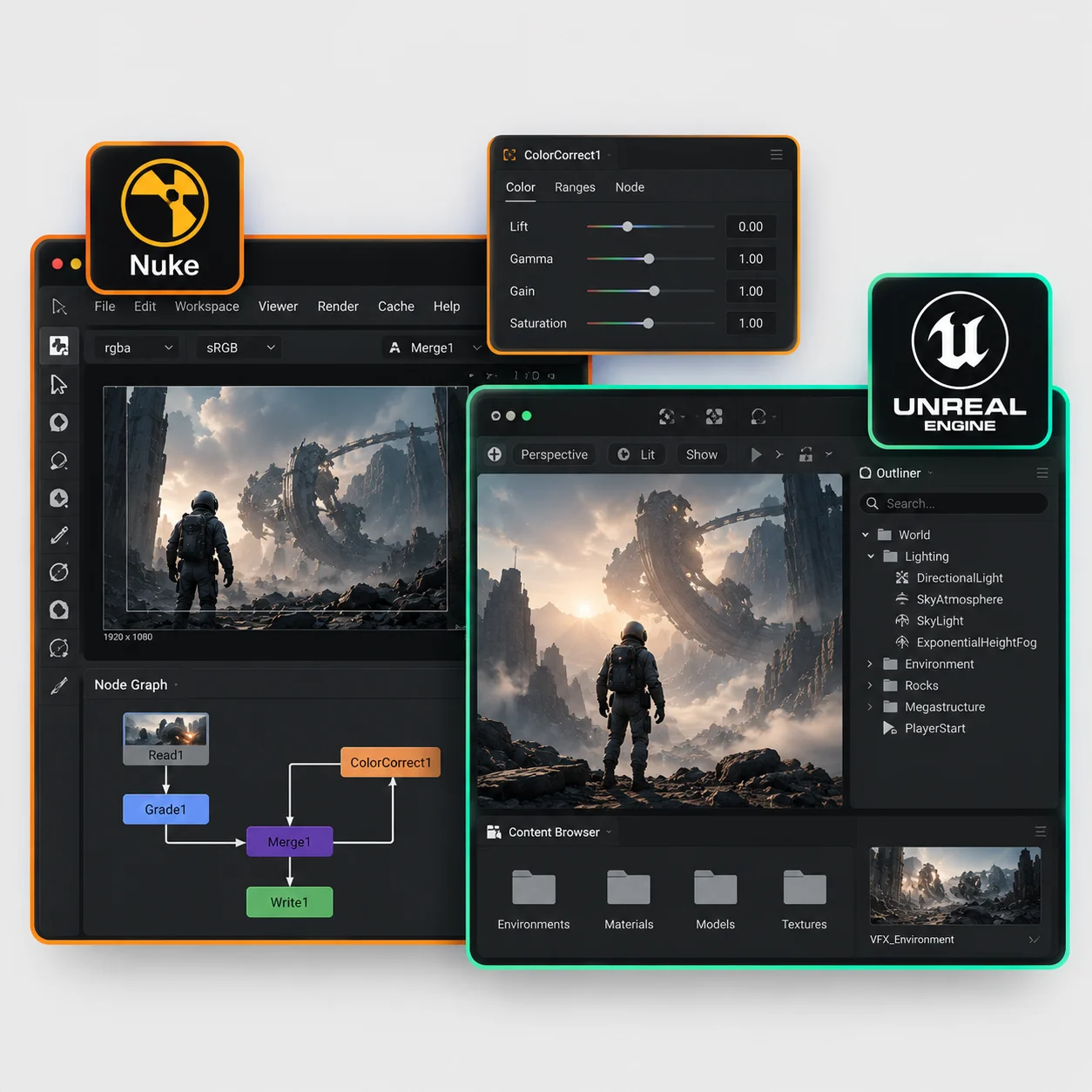
| Foundry Nuke | Professional node-based compositing, deep data, CG integration, studio pipeline |
| SideFX Houdini | Fire, smoke, explosion, fluid, destruction & particle simulations |
| Adobe Photoshop | Matte painting, clean plate work, plate prep, environment extension |
| Mocha Pro | Advanced planar tracking, roto, object removal |
| Autodesk Maya | Node-based compositing industry-used alternative to Nuke |
| Blackmagic Fusion | Concept art, matte painting, texture painting, character design |
| Adobe Premiere Pro | Final editorial & delivery pipeline |
| DaVinci Resolve | Colour grading for VFX plates & final composite |
| Unreal Engine 5 | Real-time rendering and animation preview for game & virtual production |
| Latest VFX Ai Tools | AI-assisted VFX generative backgrounds, AI roto, video generation |
Chapter 02— What You Will Learn
The Complete VFX Skill Course From Plate to Polished Shot
Introduction to Visual Effects & Studio Pipeline
Understanding Pre-Production, On-Set Supervision & Post-Production
Plate Photography, Camera Metadata, Aspect Ratios & Frame Rates
Layer-Based vs Node-Based Compositing Concepts (After Effects & Nuke Basics)
Alpha Channels, Mattes, Premultiplication & Blend Modes
Color Spaces, Bit Depth (8-bit, 16-bit, 32-bit EXR) & File Formats
Basic Color Correction & Matching Exposure Levels
Introduction to Rotoscopy & Silhouette Breakdown
Bezier & B-Spline Roto Shapes, Feathering & Edge Control
Handling Motion Blur, Hair & Fine Edge Details
Green Screen & Blue Screen Chroma Keying Fundamentals
Keylight & Core/Edge Matte Extraction Workflows
Spill Suppression, Edge Despill & Color Restoration
Combining Garbage Mattes, Hard Mattes & Soft Roto
2D Motion Tracking: Single-Point, Two-Point & Four-Point Corner Pin
Planar Tracking Fundamentals using Mocha Pro
Tracking Markers, Occlusions & Difficult Motion Paths
Footage Stabilization & Match-Moving 2D Elements
Screen Replacement for Phones, Monitors & Billboards
Adding Reflections, Glare & Screen Grain for Realism
Digital Paint & Frame-by-Frame Cleanup Workflows
Clone Stamp, Patching & Temporal Paint Techniques
Wire Removal, Rig Removal & Crew/Equipment Cleanup
Creating Seamless Clean Plates in Photoshop & After Effects
Beauty Retouching & Digital Dust/Scratch Removal
Set Extension Basics & Sky Replacement on Live Plates
Integrating Live-Action Plates with CG & 2D Elements
Light Wrapping, Contact Shadows & Atmospheric Perspective
Matching Film Grain, Lens Distortion & Optical Defocus
2D Particle Systems: Sparks, Smoke, Dust, Rain & Fire Overlays
Basic 3D Camera Tracker & 3D Layer Placement in Composite
Final Shot Color Grading & Continuity Across Sequences
Introduction to Generative AI in Modern VFX Pipelines
AI-Assisted Rotoscopy & Automated Subject Masking
AI Object Removal, Inpainting & Clean Plate Generation
AI Matte Painting & Digital Environment Extensions
Image-to-Video & AI Previsualization Concepting
Neural Upscaling, Frame Interpolation & Noise Reduction
Copyright, Studio Security & Responsible AI Usage
Analyzing a Real Production Brief & Shot Breakdown
Executing Multi-Pass Composite Shots on Cinema Footage
Rendering Pipeline, Naming Conventions & Quality Control
Creating Before-and-After Wipe Breakdowns for Showreels
Packaging an Industry-Ready VFX Showreel & Resume
Freelancing Fundamentals & Studio Interview Preparation
Chapter 03— Why Real Cinema Footage Is a Game Changer in VFX Training
The Benefit of Real Footage
Compositing is taught in all VFX Courses in Chandigarh. Most use the same stock footage clips or sample plates that are included in software tutorials. The results look just like they are practice exercises done on artificial material.
The Pikazzo students composite on real RED Dragon cinema footage: from actual film productions. This is not a matter of cosmetics. It’s a fundamental difference in the quality of skill, and the quality of portfolio work, that’s produced.
The Difficulties of Cinema Footage and Why It Matters: True cinema footage shot with a RED Dragon contains grain structure, lens distortions, lighting flaws, motion blur that is unique to cinema lenses, and dynamic range characteristics that are not found in standard footage. That’s real professional-grade skill when a VFX artist composites a CG element into real cinema footage and makes it look seamless and believable.
Pollywood Film Integration: Beyond the RED Dragon plates, Pikazzo’s active connection to Punjab’s film and music video industry means students get access to real VFX briefs from actual Punjabi film productions green screen shots to clean and composite, environments to extend, sky replacements on real location footage, crowd multiplication on actual film plates. They become real portfolio credits, not simulated exercises.
Chapter 04
— Career Opportunities
What You Can Do After This VFX Course?
India’s VFX industry is not just growing; it is transforming. The combination of world-class skill and cost efficiency has made the country a major global hub for VFX outsourcing. Studios from Hollywood, Europe and Japan are offshoring production work to Indian artists. According to NASSCOM, India will need more than 20 lakh AVGC (Animation, Visual Effects, Gaming, Comics) professionals by the year 2030. The gap between the existing talent pool and the industry needs is huge and increasing every year.
Job Roles You Can Apply For:
| Job Role | Description |
|---|
| Junior Compositor / VFX Compositor | The most common entry point into the industry; compositing CG elements, backgrounds, and effects into live-action footage |
| Rotoscoping Artist | High-demand, remote-friendly role; the gateway role for many VFX careers |
| Motion Graphics Artist | Broadcast design, OTT openers, advertising; high demand across every industry |
| Matte Painting Artist | Environment creation and extension for films, OTT, and advertising |
| FX Artist / Simulation Artist | Houdini-based fire, smoke, fluids and destruction; one of the highest-paid VFX specialisations |
| 3D Compositor | Integrating CGI renders into live-action; requires both 3D and compositing skill |
| VFX Supervisor | Senior role managing the VFX department on a production; goal-level position for experienced professionals |
| Virtual Production Artist | Unreal Engine-based real-time VFX for LED volume film productions; the industry's fastest-growing specialisation |
| Broadcast Designer | Channel branding, title sequences, and motion design for TV and OTT platforms |
| Freelance VFX Artist | Remote compositing and effects work for international clients one of the most location-flexible and income-diverse VFX career paths |
Industries Hiring VFX Artists Now: Bollywood Film Production | Pollywood & Regional Cinema | OTT Platforms (Netflix India, Amazon Prime Video, Disney+Hotstar, Zee5, Jio Cinema) | Advertising & Brand Films | Music Video Production | Gaming Studios | Virtual Production Companies | Broadcast Media & News Channels | Corporate Communications | International VFX Outsourcing Studios
FX Artist Salary in India Range: Entry-level VFX artists (rotoscoping, junior compositor) in India earn ₹15,000-35,000 per month. Mid level compositors and motion graphics artists can make 5-10 LPA with a good portfolio. Senior VFX Artists, FX Simulation Specialists, and Nuke Compositors earn ₹12-20 LPA. VFX Supervisors Salary – ₹18-35 LPA and above. Freelance VFX artists working on international remote projects pay much more, often in USD or EUR.
Chapter 05 Why Pikazzo Is the Best VFX Institute in Chandigarh
Why Choose Pikazzo Institute
10 Years of Art Creative Excellence Pikazzo is an academy of creative arts, not a generic software training center, and so our VFX students get a real artistic grounding in visual storytelling, color, composition and cinematic language. That’s the difference between a technically capable VFX artist and a truly great one.
Real Cinema Footage The Only VFX Institute in North India That Trains on RED Dragon Plates Other institutes give you stock footage to composite, Pikazzo gives you real cinema-grade RED Dragon footage from real film productions. That is a huge difference, the difference between a showreel that looks like student work and a showreel that looks like professional work. Production houses, post-production studios and VFX supervisors can tell the difference in seconds. Pikazzo students graduate with portfolio work that gets industry attention.
Houdini Where Most Institutes Stop Houdini is the highest paying specialization in the entire VFX industry and it is the tool most VFX institutes avoid because it is difficult to teach well. With Pikazzo you get full Houdini simulation training: Pyro, FLIP Fluids, RBD destruction and Vellum cloth. The graduates who can actually simulate like Houdini are instantly competitive for senior and specialist VFX jobs.
Most of the VFX courses in Chandigarh teach only After Effects AND Nuke Complete Pipeline. Pikazzo teaches After Effects (the de facto tool for Indian mid-tier productions and advertising) and Nuke (the professional pipeline standard for Bollywood and international OTT productions). Being fluent in both on graduation makes you versatile and employable in the entire gamut of Indian Vfx studios.
Connection with Active Punjabi Film Industry VFX students work on real briefs from active productions, not artificial exercises, as Pikazzo is connected to the growing Pollywood industry in Punjab. Real Pollywood VFX credits on a show reel are work currency in the North Indian film & content market.
AI VFX Tools Integrated in the Curriculum The VFX industry is embracing AI in every step of the pipeline. Pikazzo’s curriculum already features Latest Video Ai Tools and AI-assisted rotoscoping and tracking tools now being used daily in professional VFX workflows. The graduates are leaving ready for the industry as it is in 2026 and 2027, not as it was in the past five years.
- 10 YearsTraining Creative Professionals
- 15+Industry-Focused Courses
- 100%Placement Assistance