




Howdy!

We blend strategy, creativity, and technology to help brands grow, connect, and stand out in an ever-evolving digital world.

Agentic AI Course in Chandigarh

Build Autonomous AI Agents That Think, Plan & Act on Their Own

Chapter 01— Course Overview

What is the Agentic AI Course at Pikazzo Institute?

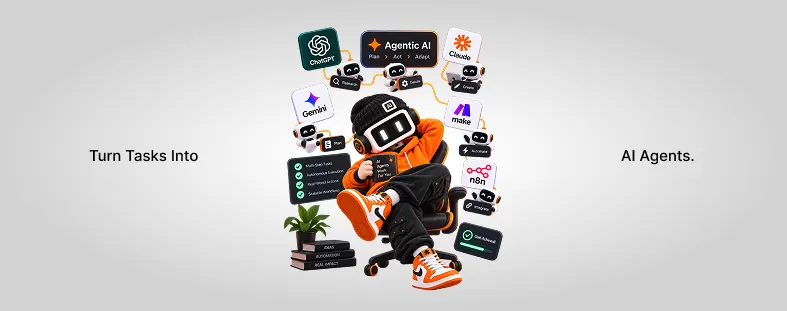
Pikazzo Institute, Chandigarh, is offering the most comprehensive AI automation course in North India – a hands-on, project-based, 6-month course for business owners, marketers, creators and working professionals who want to build systems that run without them. This course takes you from your first automated workflow to fully autonomous AI agents managing real business processes. AI automation is the process of linking AI models, applications and data sources into automated workflows to execute tasks autonomously — like sending emails, creating content, qualifying leads, updating spreadsheets, responding to customers and even running whole business operations with little human intervention. This goes beyond basic automation to agentic AI, where AI models act independently to make decisions and perform multi-step tasks, coordinated through tools such as Make.com, n8n and custom GPTs.
AI automation course at Pikazzo Institute

Software & Tools Covered

CategoryTools Covered
Agent FrameworksLangChain, LangGraph, CrewAI, AutoGen
LLMs & Reasoning ModelsGPT-4/GPT-5, Claude, Gemini
No-Code Agent BuildersMake.com, n8n, Relevance AI
Memory & Vector DatabasesPinecone, Chroma, Supabase Vector
Tool Use & Function CallingOpenAI Function Calling, REST APIs, Zapier/Make integrations
Knowledge & Data SourcesNotion, Google Sheets, Airtable, Supabase
Deployment & MonitoringVercel, Render, Streamlit, LangSmith
Chapter 02— What You Will Learn

Complete Agentic AI Course Modules

What Makes AI 'Agentic'? Goals, Tools & Autonomy Explained
Automation vs. Agents — Where Rules End and Reasoning Begins
The Agent Loop — Perceive, Plan, Act, Reflect
Single-Agent vs. Multi-Agent Systems
Real-World Use Cases of Agentic AI in Business
Setting Up Your Agentic AI Development Environment
Mapping Your First Agent Use Case

Chain-of-Thought & Step-by-Step Reasoning
ReAct — Combining Reasoning and Acting
Task Decomposition — Breaking Goals into Sub-Tasks
Self-Reflection & Self-Correction in Agents
Planning Strategies — Plan-and-Execute vs. Dynamic Planning
Evaluating an Agent's Reasoning Quality
Portfolio Project: A Reasoning Agent That Plans Its Own Steps

System Prompts That Define an Agent's Role & Boundaries
Writing Prompts for Reliable, Repeatable Agent Behaviour
Structured Outputs — JSON, Schemas & Function Arguments
Prompting for Multi-Step Tasks Without Losing Context
Prompt Templates & Reusable Agent Instructions
Debugging Agent Prompts When Behaviour Goes Wrong
Portfolio Project: A Prompt Library for a Production Agent

What Is Function Calling? Connecting Agents to the Real World
Defining Tools & Functions an Agent Can Call
OpenAI Function Calling in Practice
Connecting Agents to APIs, Databases & Web Search
Prompt Templates & Reusable Agent Instructions
Handling Tool Errors & Unexpected Results Gracefully
Chaining Multiple Tool Calls in One Task

Short-Term vs. Long-Term Memory in Agents
Embeddings Explained — How Agents 'Remember' Meaning
Setting Up a Vector Database with Pinecone
Setting Up a Vector Database with Chroma
Giving an Agent Persistent Memory Across Sessions
Memory Pitfalls — Context Overload & Stale Information
Portfolio Project: An Agent With Long-Term Memory of a User

LangChain Fundamentals — Chains, Agents & Tools
Building Your First LangChain Agent
LangGraph Fundamentals — Agents as State Machines
Building Conditional & Looping Agent Flows in LangGraph
Combining LangChain Tools with LangGraph Orchestration
Testing & Tracing Agents with LangSmith
Portfolio Project: A LangGraph Agent for a Business Workflow

Why Multiple Agents? Specialisation & Division of Labour
Building a Multi-Agent Crew in CrewAI
AutoGen Fundamentals — Conversable Agents
Agent-to-Agent Communication & Handoffs
Choosing Between CrewAI, AutoGen & LangGraph for a Project
Portfolio Project: A Multi-Agent Team Solving One Business Problem

Agent-Style Modules in Make.com
Building Autonomous Flows in n8n with AI Nodes
Combining No-Code Automation with Code-First Agents
When to Choose No-Code vs. Framework-Based Agents
Connecting No-Code Agents to WhatsApp, Email & CRM
Monitoring No-Code Agent Run

What Is RAG & Why Agents Need It
Chunking, Embedding & Indexing Documents
Building a RAG Pipeline Step by Step
Giving an Agent Access to a Private Knowledge Base
Improving Retrieval Accuracy & Reducing Hallucination
Combining RAG with Tool-Using Agents
Portfolio Project: A RAG-Powered Agent Trained on Business Documents

Why Autonomous Agents Need Guardrails
Setting Boundaries — What an Agent Should Never Do on Its Own
Human-in-the-Loop Approval Steps for High-Risk Actions
Handling Hallucination & Incorrect Agent Decisions
Logging, Auditing & Explainability for Agent Actions
Cost Control — Managing Token Usage in Autonomous Loops

Packaging an Agent for Deployment
Deploying Agents with Streamlit, Vercel & Render
Monitoring Agent Performance & Failures in Production
Versioning Prompts, Tools & Agent Logic
Scaling Agents for Multiple Users & High Volume
Security & API Key Management for Deployed Agents
Portfolio Project: A Deployed, Monitored Production Agent
Chapter 03— Why Agentic AI Is the Next Leap Beyond Automation

The Autonomous Builder's Course.

Beyond If-This-Then-That Traditional automation follows a fixed script — if X happens, do Y. Agentic AI is given a goal instead of a script, and decides for itself which steps, tools and data it needs to reach that goal. This course is built around that shift — from configuring rules to designing judgment.

Both No-Code and Code-First, By Design Not every learner needs to write Python, and not every business problem can be solved without it. That's why this course teaches agentic patterns in Make.com and n8n alongside code-first frameworks like LangChain, LangGraph, CrewAI and AutoGen — so you can pick the right tool for the job, not just the one you know.

Multi-Agent ThinkingThe most valuable agentic systems today aren't a single AI doing everything — they're teams of specialised agents that hand tasks to each other, the way a real team would. A research agent, a writing agent and a review agent working together outperform one agent trying to do all three. This course teaches you to design that kind of division of labour.

Safety Is Not an Add-OnAn agent that can send emails, spend money or update customer records also needs to know what it should never do without a human checking first. Guardrails, approval steps and logging are taught as a core module, not a footnote — because a reliable agent is defined as much by what it won't do as by what it will.

Chapter 04
— Career Opportunities

What Can You Do After This Agentic AI Course?

Agentic AI is one of the fastest-growing and highest-demand skill areas in tech right now, with companies actively hiring for roles that build and manage autonomous AI systems. Pikazzo's Agentic AI course prepares graduates for both these emerging specialist roles and the agent-enhanced versions of existing automation and development jobs.

New AI-Native Jobs You Can Apply For:
Job RoleDescription
AI Agent DeveloperDesigning and building autonomous agents using LangChain, LangGraph, CrewAI and AutoGen
Agentic AI EngineerArchitecting multi-step, tool-using AI systems for real business processes
Multi-Agent Systems ArchitectDesigning teams of specialised agents that collaborate to complete complex tasks
AI Orchestration SpecialistConnecting agents, tools, APIs and data sources into reliable production systems
RAG / Knowledge Systems EngineerBuilding retrieval pipelines that ground agents in accurate, private business data
LLMOps / Agent Reliability EngineerMonitoring, testing and maintaining deployed AI agents in production
Automation-to-Agentic ConsultantHelping businesses upgrade rule-based automations into autonomous agent systems
AI-Enhanced Traditional Roles(More Productive, More Valuable) Automation Specialist | Backend Developer | Product Manager | Data Analyst | Customer Support Lead | Operations Executive

Salary & Earning Potential Entry-level agentic AI roles in India typically start around ₹4-7 LPA, reflecting the additional technical depth over general automation work. Mid-level agent developers and AI orchestration specialists can earn ₹8-16 LPA. Senior agentic AI engineers and multi-agent systems architects command ₹18-40 LPA at product companies and AI-first startups. Freelance and contract agent builders working with international clients can earn ₹1.5-5 lakh per month depending on project complexity.

Chapter 05 Why Pikazzo Is the Best Agentic AI Institute in Chandigarh

Why Choose Pikazzo Institute

A Course Built for What's Actually Being Hired For Agentic AI is one of the most-searched, least-taught skills in the region right now — most institutes in Chandigarh stop at basic ChatGPT prompting or simple no-code automation. Pikazzo goes further, into the agent frameworks and multi-agent design patterns that companies are actively hiring for.

One Curriculum, Both Worlds Where most programs teach either no-code tools or code-first development, Pikazzo connects both — Make.com and n8n alongside LangChain, LangGraph, CrewAI and AutoGen — so you understand agentic AI as a discipline, not a single tool.

Guardrails & Reliability Are Taught, Not AssumedBuilding an agent that works once in a demo is easy. Building one that runs safely and reliably in production is the actual skill — and it's a dedicated part of this course, not an afterthought.

Learn From People Who Build & Deploy Real Agents You're learning from practitioners who design and ship agentic systems for real businesses, so every framework is taught with the practical judgment that separates a working agent from a fragile demo.

Backed by 10 Years of Creative & Technical Training Experience Pikazzo's foundation in creative arts and technology training means this course is taught with the same structured, project-first approach that has shaped our other industry-focused programs.

  • 10 YearsTraining Creative Professionals
  • 15+Industry-Focused Courses
  • 100%Placement Assistance
pikazzo

Need Guidance?

Our mentors are just one click away to help you stay on track.

FAQFAQ

Agentic AI Course FAQs — Pikazzo Institute, Chandigarh

Pikazzo Institute offers an Agentic AI Course in Chandigarh covering AI agent frameworks like LangChain, LangGraph, CrewAI and AutoGen, tool use, memory systems, RAG, multi-agent orchestration, and real-world deployed agent projects.

AI Automation follows fixed, rule-based workflows, while Agentic AI is given a goal and decides on its own how to reach it — planning steps, calling tools, checking its own work and adapting when a task doesn't go as expected.

Basic coding familiarity helps for the LangChain, LangGraph, CrewAI and AutoGen modules, but the course starts from the fundamentals and also covers no-code agentic workflows in Make.com and n8n, so committed beginners can follow along.

Pikazzo Institute offers an Agentic AI Course in Chandigarh with real deployed multi-agent projects, an industry-ready portfolio, internships, industry-relevant training, certification and placement support.